


Minimalism and decluttering have seen a significant rise in popularity in recent years. What began as simple organizing practices have evolved into true philosophies of life. Going far beyond the “spring cleaning,” the minimalist movement invites us to take a deep look at our relationship with objects and consumption. For many, it’s about focusing more on what’s essential and freeing themselves from what’s superfluous. If you’d like to adopt a simpler, less cluttered, and healthier lifestyle—or if you’re someone who needs a storage unit to make this transition—this article is for you.
In this article, we explore :
- The origins and principles of minimalism
- Concrete benefits for your well-being, finances and productivity
- Practical tips and methods for effectively decluttering your space
Let’s discover the exciting world of minimalism and see how this trend can transform your everyday life.
What is minimalism?
Minimalism is a movement that advocates the voluntary reduction of material possessions. The idea is to get rid of everything that doesn’t provide real utility or lasting satisfaction. In other words, it’s all about keeping the essentials and eliminating the superfluous, in order to make room both physically and mentally.
Origins of the Movement
Contemporary Minimalism has its roots in various philosophical and religious currents, such as Buddhism and Stoicism, which value simplicity. However, it was in the 1960s-1970s that it really emerged as a cultural movement, particularly in the arts. In the 2010s, minimalism took on a wider dimension thanks to the media and certain authors or influencers (notably Marie Kondo, Joshua Fields Millburn and Ryan Nicodemus).
Basic principle: “Less is more”
A famous quote by Ludwig Mies van der Rohe, a pioneering architect of modernism, perfectly captures the essence of minimalism: “Less is more.” This approach suggests that reducing the number of objects and elements in one’s living space helps create a more serene, fluid, and functional atmosphere.
Minimalism, an art of living
Minimalism isn’t just about sorting out your attic or garage. It’s a veritable art of living that extends to different areas:
- Consumption: quality over quantity
- Finances: avoid impulse buying and focus on saving or investing in durable goods
- The relationship with time: freeing up time for what really matters (family, leisure, personal development)
- Space management: a pleasant, orderly environment
The Benefits of Minimalism
Adopting minimalism offers a series of benefits that go far beyond simply saving space in the home.
Mental well-being and serenity
A cluttered environment can cause stress, because every extra object constantly demands your attention. By reducing the number of everyday objects, you directly lighten your mental load. As RTS explains in its segment on decluttering to simplify your life and rediscover meaning, decluttering goes beyond mere physical organization: it’s a powerful tool for freeing up mental space, promoting concentration, and regaining lasting peace of mind.
Time saving
Fewer possessions means less time spent on tidying, cleaning and maintenance. On a day-to-day basis, the time saved is considerable: you can find what you’re looking for more easily, and avoid wasting hours sorting through useless belongings.
Financial Savings
Minimalism encourages you to buy less, but better. In the long run, you save on frivolous purchases and invest in quality, longer-lasting objects. Your finances gain in stability, and you can devote your money to more rewarding experiences or projects.
Ecological impact
By reducing your consumption and sorting your waste, you also limit your ecological footprint. You buy fewer manufactured and shipped items, and you throw away less. Minimalism is fully in line with the circular economy and resource management strategy promoted by the Federal Office for the Environment (FOEN): it encourages reuse, recycling, and upcycling, thereby contributing to a more environmentally friendly lifestyle.
Higher Productivity
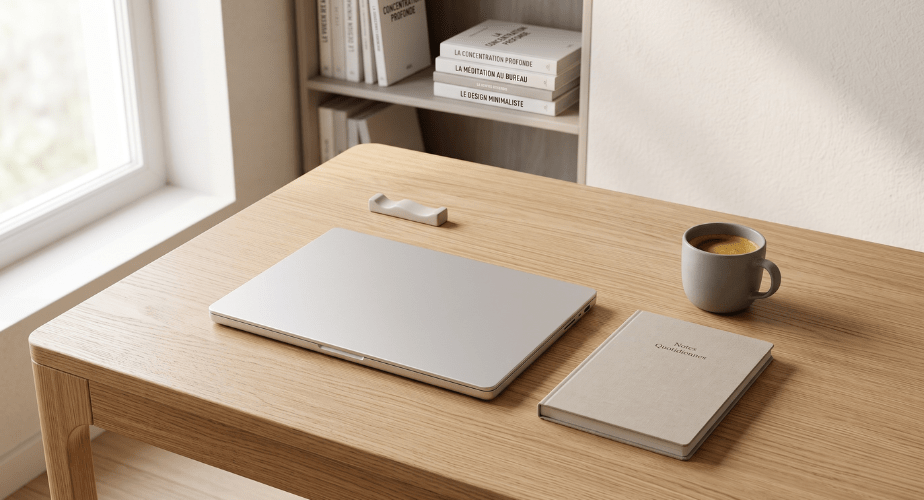
An uncluttered workspace, free from distractions, stimulates concentration. You can immerse yourself in your tasks without being constantly interrupted by distracting visual elements. The result: greater productivity and higher quality in what you do.
Decluttering: the keys to success
Decluttering is the first concrete step in adopting a minimalist lifestyle. Here are a few methods and tips to get you started.
Make an inventory
First and foremost, it helps to know exactly what you own. Draw up an inventory of your possessions, room by room, to get an overview. This will help you realize just how much you’ve accumulated over the years.
The 3-pile rule (or 4, depending on the method)
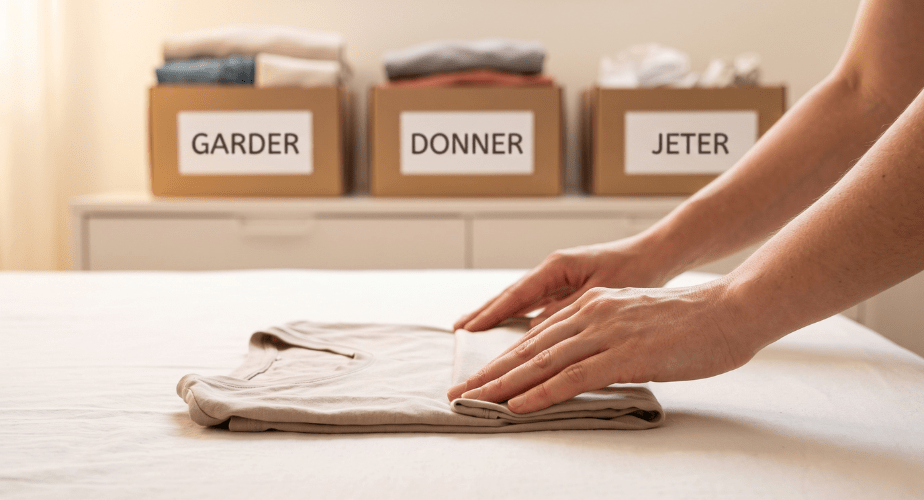
The classic way to sort is to divide your items into three piles:
- Keep: items you use regularly or that have a strong sentimental value.
- Donate/sell: anything you no longer use, but which is still in good condition.
- Discard / recycle: objects that can no longer be used or given away.
Some people add a fourth “To be decided later” pile for items they’re not sure about yet, so they don’t get stuck.
The KonMari method
Popularized by Marie Kondo, the KonMari method involves sorting by category (clothes, books, papers, etc.) rather than by room. For each item, you ask yourself if it “sparks joy.” If the answer is no, you thank it and let it go. This introspective approach helps you reconnect with the emotional value of your possessions.
Giving Your Belongings a Second Life
Decluttering doesn’t have to mean throwing things away. On the contrary, it’s an opportunity to donate, sell or recycle. In this way, you contribute to a more rational use of resources.
Here are a few tips:
- Charities: Emmaus, the Red Cross, etc.
- Resale sites: LeBonCoin, Facebook Marketplace, etc.
- Friends and family: Perhaps those around you are looking for just the thing you no longer need.
Organizing the remaining space
Once you’ve sorted, it’s time to rethink your storage. Use boxes, modular shelves, drawer dividers and so on. The aim is to make each item easy to access and assign it a precise place.
Gradually Adopting a Minimalist Lifestyle
Once the decluttering phase has begun, you can extend this approach to other aspects of your daily life.
Simplify your wardrobe
Clothes are often one of the main sources of clutter. Adopt the capsule wardrobe technique: put together a minimalist wardrobe of a few versatile, quality pieces. You’ll save time in the morning and reduce the amount of laundry you need to wash, iron or put away.
Set rules for your consumption
To avoid slipping back into clutter, set yourself some simple rules:
- One new item in, one new item out: for every new item purchased, an old item must be removed.
- A period of reflection before buying: wait 24 to 48 hours before making a non-essential purchase. Very often, the desire will pass by itself.
- Targeted shopping lists: don’t be tempted by promotions on products you don’t need.
Digitizing to save space
Thanks to digital tools, it’s now possible to store documents, photos and videos online or on external hard drives. Digitizing your administrative papers frees up space in your cupboards. However, be sure to back up your files on several media to avoid any loss.
Experiments rather than objects
Investing in quality moments (trips, courses, cultural outings) rather than material goods is one of the cornerstones of minimalism. Memories don’t clutter up your home, and provide more lasting personal enrichment.
Common challenges and how to overcome them
Moving from a hoarding lifestyle to a minimalist lifestyle is not without obstacles.
Sentimental attachment
Some objects have strong sentimental value. It can be difficult to part with them. Try the following method:
- Keep a symbolic memento (a photo, a small object) rather than all your belongings.
- Take photos to keep a visual record and lighten your physical space.
The fear of regret
Many people hesitate to get rid of an item for fear of needing it in the future. One strategy is to temporarily store anything you’re not sure about in a box. Seal the box and write down the date. If you haven’t reopened the box after six months or a year, it’s very likely that its contents are no longer essential to you.
Social Pressure
Our society often values possession and novelty. Going against the grain can be misunderstood by those around you. Explaining your motivations and demonstrating your new-found well-being can reassure and even inspire them.

Why use self-storage as part of a minimalist approach?
Self-storage may seem paradoxical in a context of decluttering. Yet it’s an excellent compromise for those who want to adopt a more minimalist lifestyle without giving up everything.
A space of transition
Self-storage can be used as a temporary space for things you don’t yet know if you should part with. You can put them safely away, experience life without them and decide what to do with them later.
Storing Seasonal Items
Skis, Christmas decorations, camping equipment… Some items are only used at certain times of the year. Storing them outside your home allows you to keep your interior uncluttered, while still having your belongings available when you need them.
Saving Space at Home
Whether you live in an apartment or a house, space is often limited. To make sure you make the right choice, check out our tips for selecting the right storage unit. This way, you’ll optimize your living space for your comfort while keeping your belongings within easy reach.
Preparing for a move or redevelopment
Before a move, using a storage unit is especially helpful. This way, you can pack your boxes gradually, without being overwhelmed by items scattered everywhere. Before a move, using a storage unit is especially helpful. Once you’ve done this major sort-through, all that’s left is to pack your moving boxes with the items you’ve actually chosen to keep, then store them gradually without cluttering up your living space. Similarly, if you’re planning to renovate or remodel your home, self-storage makes the transition easier and protects your belongings during the work.
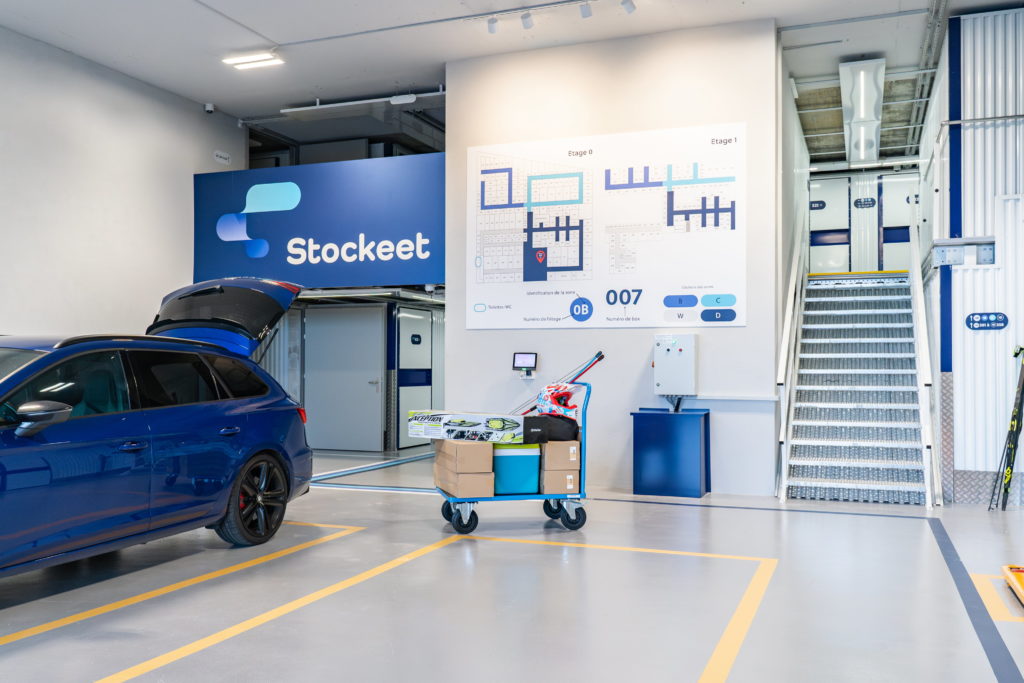
Stockeet: your ally for serene minimalist living
Stockeet is a self-storage company based in Aclens (15 minutes from Lausanne in the canton of Vaud) that can help you with your decluttering and minimalist lifestyle projects. Do you want to make space in your home without throwing everything away? Stockeet offers storage solutions tailored to your needs and budget.
Flexible and Secure Services
- A wide range of boxes: Whether you need to store a few boxes or bulky pieces of furniture, Stockeet can provide you with boxes of different sizes.
- Security for your belongings: Video surveillance, access control, alarms… Stockeet provides a high level of protection to keep your belongings safe.
- Flexible contracts: You decide how long you want to store your goods (short or long term), with no unnecessary commitment.
Customer Service That Listens
- Personalized support: The Stockeet team will advise you on the choice of storage space required, so that you only pay for the space you really need.
- Moving aids: On request, we can provide you with practical tools (carts, hand trucks, etc.) to help you transport your belongings to the box.
- Flexible access times: access your goods when you need them, without constraints.
Comfort and convenience
- Cleanliness and ventilation: The premises are regularly maintained to ensure a healthy environment for your business.
- Easily accessible locations: Stockeet is generally located in well-served areas, with parking spaces nearby.
Stockeet’s Competitive Advantages
- Regional expertise: Stockeet understands the specific needs of Swiss customers, particularly in terms of the limited living space available in urban centers.
- Competitive rates: Despite a top-of-the-range service, prices are designed to remain affordable.
- Responsive, human service: With Stockeet, you’re not a number. Our team values a relationship of trust, and is always available to answer any questions you may have.
How to Take It Further
Minimalism and decluttering are much more than just a trend: they respond to a deep-seated need to regain space, time and serenity in a world that is often too hectic. As you embark on this process, you will gradually :
- Gain clarity of mind and better manage stress.
- Save money by buying less, but better.
- Reduce your environmental impact by consuming more responsibly.
- Live in an interior that reflects your true priorities and gives you real well-being.
But parting with all your possessions isn’t always the answer. Some items may be indispensable at certain times of the year, or have sentimental value that you’re not prepared to give up. Stockeet’s self-storage service is an excellent alternative. You can move forward with your minimalist approach, while retaining the possibility of retrieving your belongings if necessary.
Contact Stockeet to find the right solution for you
Ready to take the step towards a more minimalist lifestyle? Get in touch with Stockeet for :
- Get personalized advice: The team will help you assess your needs and suggest the most suitable storage solution.
- Book a stall: Choose the size and duration to suit your project.
- Visit the facilities: Schedule an appointment to explore the premises, check safety and see the level of service on offer.
Call Stockeet now to speak with an advisor and schedule a visit. Take advantage of this opportunity to see for yourself the quality of our storage spaces and the support we offer.
Contact details :
- Telephone: 021 800 30 00
- Address: Chemin du Coteau 29a, 1123 Aclens
When you choose Stockeet, you’re choosing a local, experienced and committed service provider. Give your home the space and harmony it deserves, while retaining the freedom to retrieve your belongings at any time.
Need to see our efficiency for yourself?
Contact us for more information or to make an appointment to visit our storage facility. You’ll discover how Stockeet’s ultramodern, 100% digitalized operation offers you a totally secure storage unit rental with no unpleasant surprises.
📞 Contact us today on: 021 800 30 00

