
You’ve finally signed the lease on your new home, and the date for the big day has been set. Congratulations! But as the first boxes pile up in your living room, a slight anxiety begins to mount. How are you going to get your whole life from point A to point B without turning this day into a logistical nightmare?
While hiring a specialized company can sometimes be costly—and requires caution to avoid moving scams —taking matters into your own hands is an excellent alternative. In fact, most people prefer to handle this transition themselves. However, to ensure everything goes smoothly, renting a moving truck in Switzerland is a step that requires preparation. Choosing a vehicle that’s too small will force you to make multiple exhausting trips back and forth, while a van that’s too large will put an unnecessary strain on your budget and be difficult to maneuver.
In this comprehensive guide, we take you step by step to determine the ideal volume, understand road regulations, optimize your rental and anticipate unforeseen circumstances. On your way to a worry-free move!
Assessing the volume of your goods: the crucial first step
This is the number one mistake made by self-movers: underestimating the amount of stuff they’ve accumulated over the years. General industry statistics show that almost 70% of individuals rent a vehicle that is not suited to their actual volume.

The golden rule of volume calculation
When it comes to determining the size of truck you’ll need for your move, it’s best not to trust your instincts. The most common method is to divide the surface area of your current home by two. For example, if you live in a 40 m² apartment, you’ll need a 20 m³ van. Of course, this formula is an estimate that needs to be refined if you own particularly massive pieces of furniture (such as large Norman wardrobes or a piano), or if you’re a fan of minimalism.
💡 Pro tip:
Proper packing helps maximize space in the small truck. Feel free to check out Our guide to packing your boxes efficiently to save valuable cubic meters.
Size guide: which vehicle for which home?
To help you visualize, here’s a handy correspondence table to keep in mind:
| Housing size | Estimated volume | Recommended vehicle type |
| Student room (10-15 m²) | 5 to 7 m³ | Van (Renault Kangoo type) |
| Studio / 2-room (20-35 m²) | 10 to 12 m³ | Small van (Mercedes Vito type) |
| 3-room apartment (40-60 m²) | 20 to 22 m³ for | Van with tailgate (type Iveco Daily) |
| House / 4 rooms and more (>70 m²) | 30 m³ and more | Large trucks or more routes |
📦 To remember:
Never choose your van at random. Calculate your volume by dividing the surface area of your home by two, and always allow for a 10-15% margin of error to avoid unpleasant surprises on the big day.
2. Which driver’s licence for which van?
Once the volume has been determined, a legitimate question arises: are you allowed to drive the vehicle you want? Road traffic regulations are strict, and renting a commercial vehicle with a “B” license is subject to precise rules that must be respected.
The 3.5-tonne limit (Permis B)
With a standard Class B driver’s license (passenger car), Swiss traffic law (LCR) allows you to drive a vehicle with a Gross Vehicle Weight Rating (GVWR) not exceeding 3,500 kg (3.5 metric tons). This includes the vehicle’s curb weight, the weight of passengers, and, of course, the weight of your cargo. The vast majority of utility vehicles with capacities ranging from 10 to 22 m³ offered by rental agencies fall into this category.
Beware of the “payload” trap
This is where things get complicated. The bigger and better equipped a van is (for example, with a tail-lift for heavy loads), the heavier it is when empty. As a result, its “payload” (the total weight of furniture and boxes you can fit inside) decreases.
It is not uncommon for a large 20 m³ truck to be legally limited to carrying only 800 kg of cargo before exceeding the 3.5-metric-ton weight limit. If you’re transporting very heavy items (books, appliances, tools), be sure to follow the regulations set bythe Federal Roads Office (OFROU) to avoid fines in the event of a weigh-in by traffic authorities.
📦 To remember:
Your “B” driving license is sufficient for most removal trucks up to 3.5 tons. Always check the “payload” of the rented vehicle to make sure you can transport your heaviest furniture legally.
3. Compare prices and understand your rental contract
The cost of renting a removal van can vary from one to three times the price, depending on the time of year, the agency and the options you choose. To control your budget, you need to read between the lines.
Factors that influence pricing
- Time of rental: Moving on a Saturday at the end of the month (when leases traditionally end) will cost you considerably more than renting a van on a Tuesday in the middle of the month.
- Mileage: Packages generally include a limited number of kilometers (often 100 km). If you’re moving a long distance (especially if you plan to move to Switzerland from abroad), be sure to calculate the round-trip distance carefully to avoid extra charges per additional kilometer.
- Insurance and deductibles: This is the crucial point. In the event of bodywork scratches, the basic deductible can amount to several thousand francs. Always opt for supplementary insurance (deductible buy-back) to reduce this amount.
Vehicle inventory
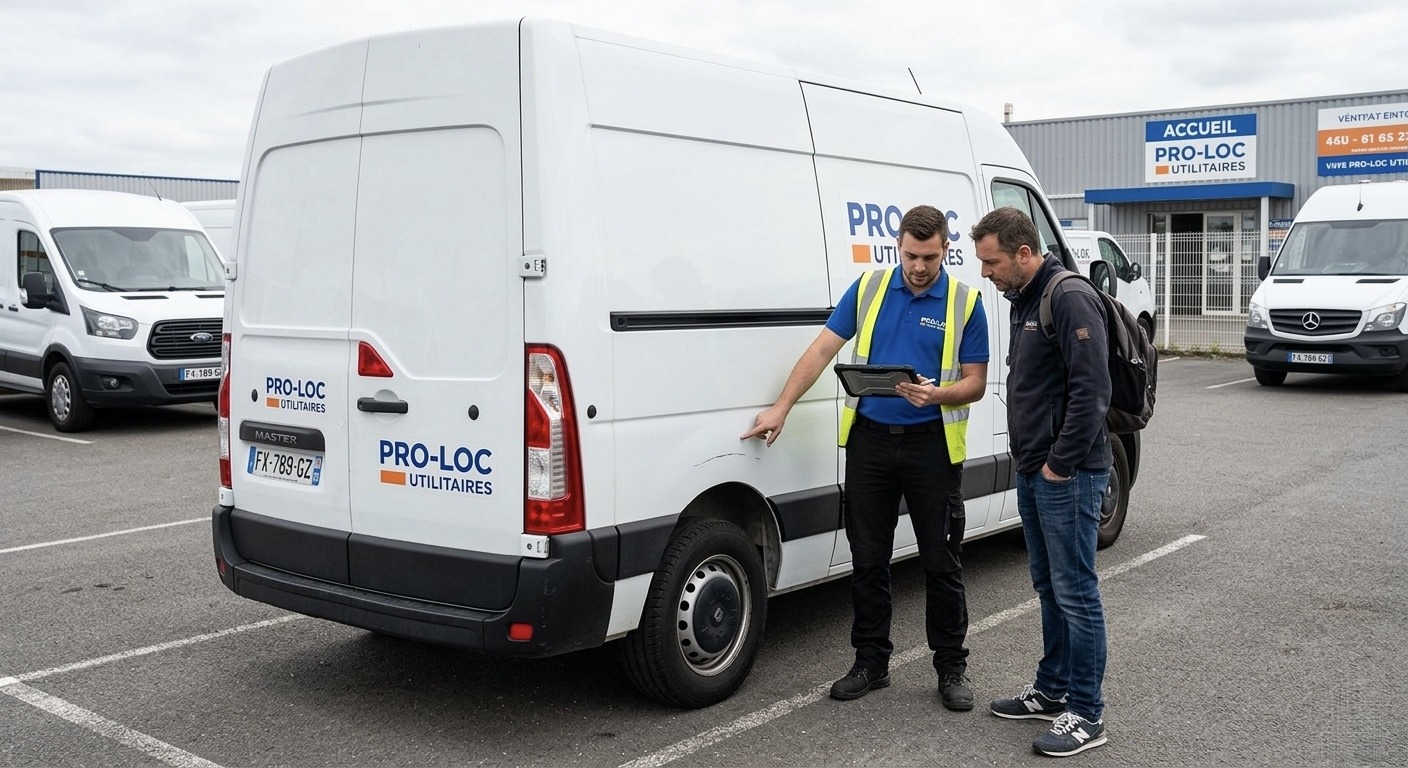
Before you sign the contract and get behind the wheel, inspect the van meticulously. Note every scratch, impact on the windscreen or dent in the bodywork in the presence of the rental company. Don’t hesitate to take pictures with your smartphone, time-stamped. This will help you avoid paying for damage caused by previous renters.
📦 To remember:
Compare offers, including the actual mileage you’ll need and the cost of buying back your excess. A low introductory price often conceals high additional costs. Never neglect the departure inventory.
4. Driving a heavy vehicle: rules and safety
Driving a 20 m³ van is nothing like driving your usual city car. The sheer size of the vehicle calls for extra vigilance to ensure your safety and that of your furniture.
Understanding the template
- Height: A moving van is often almost 3 metres high. Forget underground parking lots and drive-ins, and be extremely careful of low bridges, which are very common on secondary roads. Memorize the exact height of your vehicle (usually indicated on the dashboard).
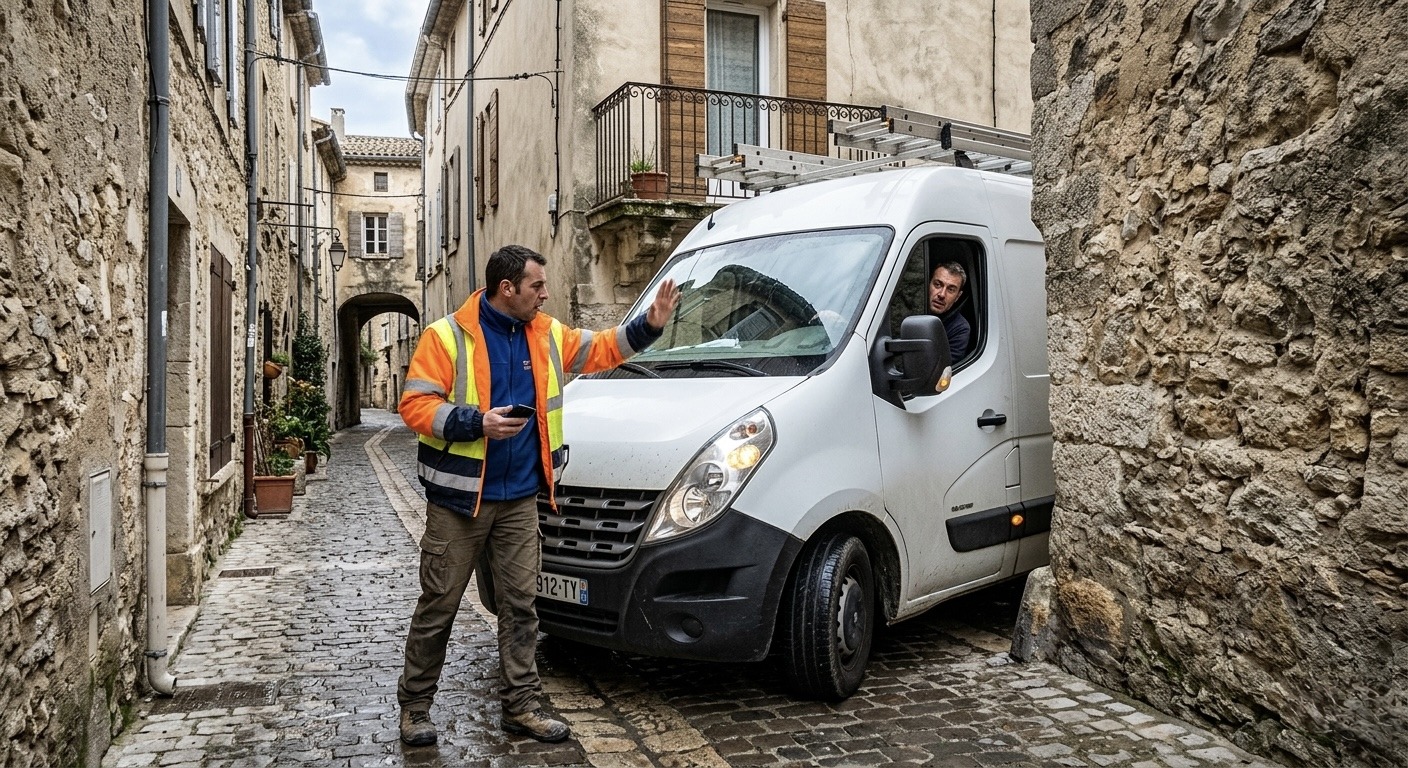
- Length and wheelbase: A longer vehicle requires you to take corners much wider than usual. If you steer too soon, you risk rubbing the side of the vehicle against a wall, post or kerb. Take your time at intersections and traffic circles.
- Blind spots: Trucks have no central rear-view mirror (because of the rear body), so you need to use your outside mirrors constantly. When maneuvering, always ask someone close to you to guide you from the outside.
Adapting your driving style
The weight of your load modifies the vehicle’s behavior. Braking distances are considerably longer, and the higher center of gravity makes the van sensitive to side winds. Adopt a flexible driving style, anticipate braking and reduce your speed, especially on the freeway or on the winding downhill stretches of our mountains.
💡 Pro tip:
Successful driving also requires thorough preparation beforehand. To make the most of your moving day, check out these essential steps to make your move go smoothly.
📦 To remember:
Take wide turns to avoid damaging the sides, obsess about height to avoid ripping the roof off, and anticipate your braking. Never manoeuvre in reverse without the help of a guide on foot.
5. Materials and equipment: optimizing space and protecting your assets
It’s not enough to hire the right removal truck; you also need to equip it correctly. A poorly secured load is dangerous, and can cause irreparable damage to your belongings at the slightest jolt.
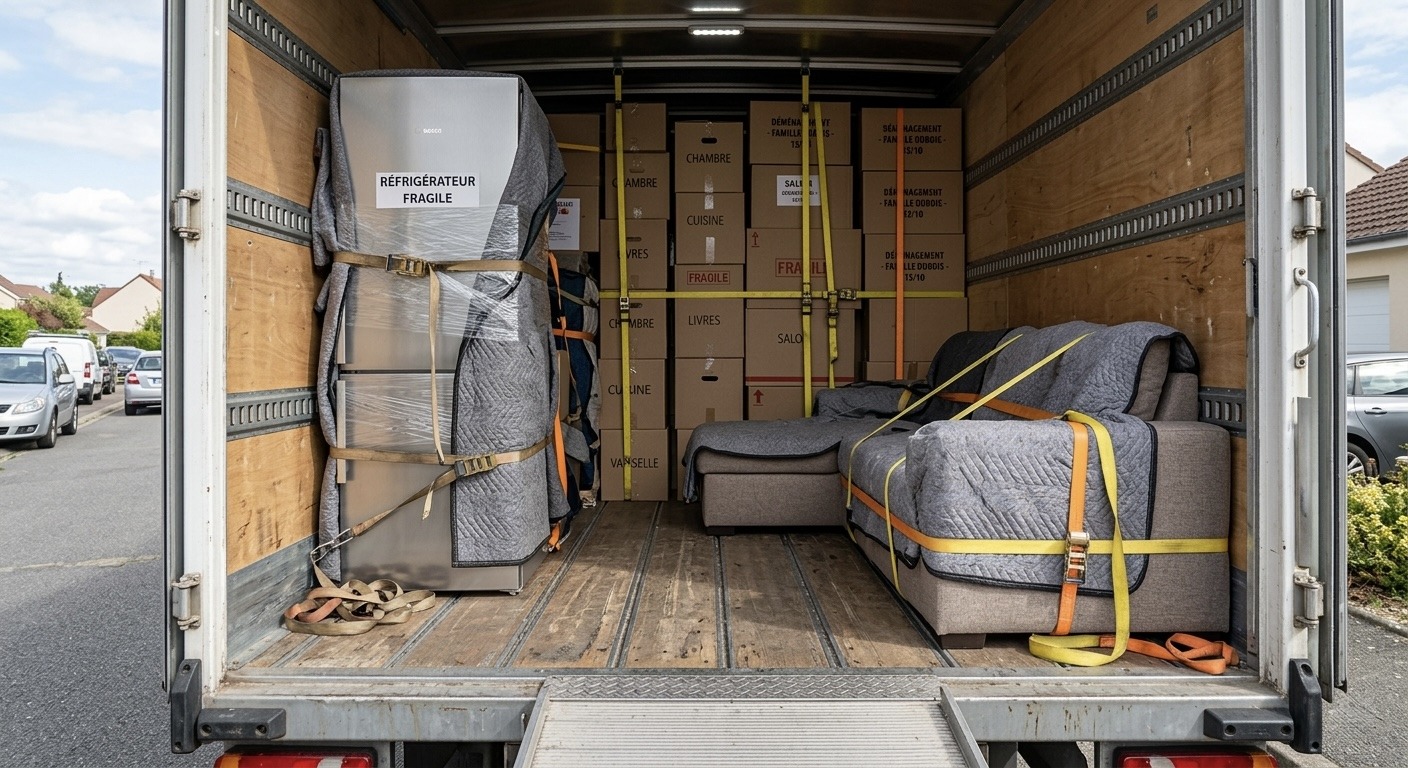
- Tie-down straps: These are indispensable. Professional vans are equipped with rails for securing to the interior walls. Strap your heavy furniture (refrigerator, washing machine, cupboards) to the walls to prevent them from tipping over.
- Protective blankets: Don’t skimp on blankets. They protect the corners of your wooden furniture and TV screens, and prevent objects from rubbing against each other during transport.
- The hand truck: Often offered as an option by rental agencies, the hand truck is your best ally for protecting your back and transporting several stacked boxes or heavy appliances from your landing to the truck’s tailgate.
📦 To remember:
Don’t leave empty-handed! Rent or buy straps, thick blankets and a hand truck. A firmly secured load guarantees the integrity of your belongings during the journey.
6. Moving contingencies: what if everything doesn’t fit?
Even with the best planning in the world, the reality on the ground can sometimes hold surprises. It often happens that the new home is smaller than expected, that a cellar is missing, or that refurbishment work is behind schedule, preventing you from installing all your furniture immediately.
What should you do with your belongings still in the back of the rented truck, which you must return to the agency by 6pm?
It’s precisely at these times of transition that renting a storage unit comes into its own. Temporarily storing your furniture gives you immense peace of mind. You don’t have to throw away your belongings in a hurry, or clutter up the living room of your newly-painted apartment.
💡 Pro tip:
To learn more about this topic, check out “Why Choose a Rental Storage Unit During a Renovation in Switzerland?” or consult our guide “What Size Storage Unit Is Right for You? ”

📦 To remember:
You’ve found the perfect van, but you realize you’re running out of space to store some of your belongings until you finalize your layout?
Don’t let lack of space spoil the joy of your new beginning. At Stockeet, we offer secure, flexible self-storage solutions tailored to your needs, whether for a few weeks or several months. Enjoy clean, easily accessible spaces protected by the best security systems in Switzerland.
Would you like to know more about our rates, or would you like some advice on estimating the right size of cubicle for you? Our experts are here to help you through this transition period.
📞 Contact us today on: 021 800 30 00